



On This Page You Will Find
- The rising number of TFWs in Canadian health care
- Where health care TFWs are working: hospitals, care homes, home care
- Why foreign workers are key to solving labour shortages
- Transition to permanent residency for health care TFWs
- Retention trends and long-term impact
Canada’s Health Care Sector Is Facing a Labour Crisis
Canada’s health care system has been under increasing pressure for years, and the COVID-19 pandemic only made things worse. Hospitals, long-term care facilities and home care providers are struggling to find enough qualified workers. Many nurses and support staff have left the profession, and overtime hours are rising. The shortage is especially severe in residential care and home care, where burnout and low wages are common.
To help close these labour gaps, Canada has turned more often to temporary foreign workers (TFWs). These individuals come to Canada on work permits to take on roles that employers are struggling to fill. Many of them work in health care jobs that are vital to the well-being of seniors and people with disabilities.
The Number of Health Care TFWs Has Grown Rapidly
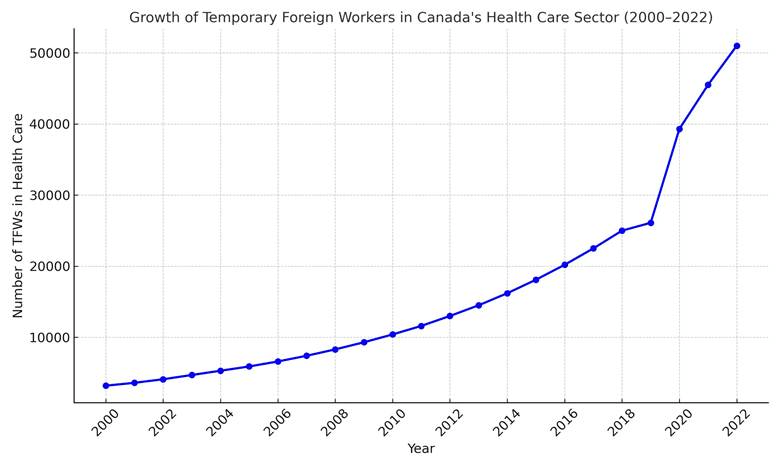
According to a recent Statistics Canada study, the number of TFWs working in Canada’s health care sector rose from just 3,200 in the year 2000 to 57,500 in 2022. That’s a 17-fold increase over two decades.
This growth accelerated during the COVID-19 pandemic. Between 2019 and 2020 alone, the number of TFWs in health care jumped by 50 percent. The trend has continued as Canada faces a persistent shortage of qualified health workers.
While TFWs once mostly worked in hospitals, they are now far more common in nursing homes and home care services. In 2022, nearly 5 percent of all workers in nursing and residential care facilities were TFWs. In home health care services, that share reached almost 8 percent.
Who Are These Workers and Where Do They Come From?
TFWs in health care come from many different countries, but two stand out: the Philippines and India. Workers from the Philippines made up a large share of health care TFWs in the early 2000s, particularly in home care and nursing support roles. More recently, Indian workers have overtaken them, making up nearly one-third of the total health care TFW workforce in 2022.
These workers often hold either occupation-specific work permits under the Temporary Foreign Worker Program (TFWP) or open work permits under the International Mobility Program (IMP). Some arrived in Canada as international students or refugee claimants and later moved into health care roles.
TFWs Are Vital to Staffing Canada’s Nursing Homes and Home Care
Long-term care facilities and home care services have been hit especially hard by staff shortages. These sectors are often seen as less desirable due to physically demanding work and lower pay. But they are essential to supporting Canada’s ageing population.
Temporary foreign workers have stepped in to fill many of these roles. In 2022, TFWs represented:
- 4.9% of the total workforce in nursing and residential care facilities
- 3.0% in ambulatory health care services
- 1.2% in hospitals
In provinces like Prince Edward Island, Nova Scotia and Ontario, the percentage was even higher than the national average. Ontario alone employed 43 percent of all health care TFWs.
Transition to Permanent Residency Is Becoming More Common
TFWs are not just temporary help. Many are choosing to stay in Canada long term and apply for permanent residency. This creates a more stable workforce and benefits the health care system over time.
The StatsCan report shows that more recent cohorts of TFWs are more likely to transition to PR. For example, 59.6 percent of TFWs who began working in health care between 2010 and 2014 became permanent residents within five years. That’s up from 54.5 percent for the 2000–2004 cohort.
Special immigration streams like the Canadian Experience Class, Provincial Nominee Program, and the 2021 Temporary Resident to Permanent Resident Pathway have supported these transitions.
TFWs With Health Occupation Permits Are More Likely to Stay in the Sector
Not all TFWs who gain PR remain in health care. However, those who originally held occupation-specific health care work permits are much more likely to continue in the field.
One year after gaining PR, over 80 percent of these workers were still in health care roles. Even after five years, more than 75 percent remained. By contrast, TFWs with open work permits or unrelated jobs had lower retention rates, with less than half staying in the health sector long-term.
This shows that those who come to Canada specifically to work in health care are more committed to the field – and likely to stay if supported.
Policy Implications: Why Canada Needs to Support These Workers
TFWs have become an essential part of Canada’s health care workforce. But their long-term contribution depends on fair treatment, pathways to PR, and opportunities for career growth.
Some key policy considerations include:
- Streamlined immigration pathways for TFWs in health care
- Support for credential recognition so they can upgrade or specialise
- Fair wages and working conditions in long-term and home care settings
- Geographic distribution strategies to support provinces with high needs
The reliance on TFWs also raises broader questions about whether Canada is investing enough in domestic training and retention of health care workers. Temporary solutions can help, but long-term workforce planning is essential.
Backbone of Canada’s Care System
Temporary foreign workers are playing a critical role in keeping Canada’s health care system running. They are stepping into difficult roles at a time when staffing shortages are at a crisis point. Many are staying in Canada long term and continuing to support patients and families in hospitals, care homes and private residences.
As demand continues to rise, these workers deserve recognition, support, and clear pathways to permanent residence. They are not just filling gaps – they are becoming the backbone of Canada’s care system.
FAQ
Why is Canada relying more on temporary foreign workers in health care?
Because of growing shortages in hospitals and long-term care homes, especially since COVID-19, Canada needs more workers. TFWs help fill jobs that are hard to staff with domestic labour.
What kinds of jobs do TFWs do in health care?
TFWs work as nurse aides, caregivers, personal support workers, and in some cases as nurses or doctors. Many also work in home care or residential care facilities.
Are temporary foreign workers allowed to stay in Canada permanently?
Yes. Many apply for permanent residency through programs like the Canadian Experience Class or Provincial Nominee Program. Transition rates have increased in recent years.
Which countries do most health care TFWs come from?
The Philippines and India are the top source countries. Together, they account for over half of all TFWs in Canada’s health care system.
Do these workers stay in health care after becoming permanent residents?
Many do – especially those who had health-specific work permits. About two-thirds remain in health care after PR, though retention is lower for those with general work permits.