



On this page you will find
- How Canada shifted to in-country immigration selection
- The impact of pandemic-era policies
- Trends across study permit, IMP and TFWP pathways
- What the 2026 slowdown signals
- What this means for future immigrant
Canada has quietly transformed how it selects new permanent residents. Instead of relying primarily on candidates from abroad, the system now draws heavily from people already inside the country on temporary permits.
New data on transitions from temporary to permanent residence shows this shift is no longer temporary. It is now a defining feature of Canada’s immigration system.
A system reshaped during the pandemic
Before 2020, most permanent residents were selected from abroad or transitioned in relatively modest numbers from temporary status.
That changed dramatically during the pandemic.
With borders closed, Canada turned inward. The federal government introduced targeted measures to convert temporary residents into permanent residents, most notably the 2021 temporary resident to permanent resident pathway.
The result was a surge in in-country transitions.
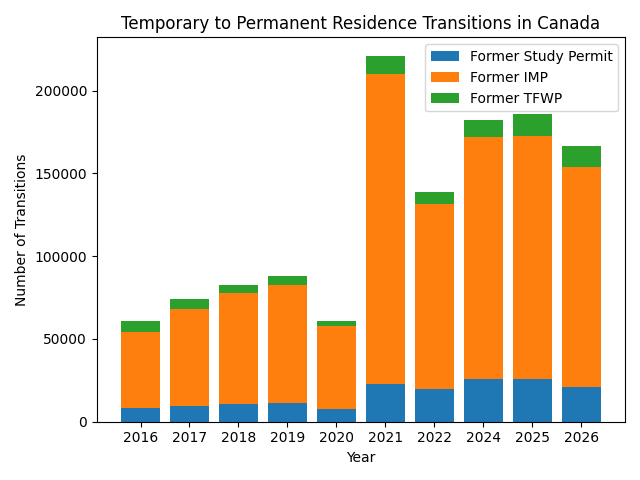
Former International Mobility Program work permit holders saw the most dramatic increase. Numbers jumped from 70,825 in 2019 to 187,510 in 2021, nearly tripling in just two years.
Former study permit holders also saw a sharp rise, from 11,570 in 2019 to 22,680 in 2021.
This was not organic growth. It was a deliberate policy response to extraordinary circumstances.
A structural shift, not a temporary spike
What is striking is what happened next.
Even after the pandemic, transition numbers did not return to pre-2020 levels. Instead, they stabilised at much higher volumes.
Former International Mobility Program participants continued to account for the largest share of transitions:
- 2024: 146,220
- 2025: 147,305
- 2026: 132,805
These figures are roughly double the levels seen before the pandemic.
Former study permit holders also maintained elevated levels, stabilising between 20,000 and 25,000 per year.
This suggests Canada has not reverted to its previous model. Instead, it has embedded in-country selection as a core feature of its immigration system.
The quiet rise of worker transitions
While much attention focuses on high-skilled mobility pathways, the data also shows a gradual increase in transitions from the Temporary Foreign Worker Program.
Numbers rose from just 3,295 in 2020 to 12,930 in 2026, the highest level in the dataset.
Although still smaller than other pathways, this trend suggests expanding opportunities for workers in employer-driven streams to move into permanent residence.
It also reflects ongoing labour market needs in sectors that rely on temporary foreign workers.
2026 signals a turning point
The latest figures show a noticeable decline in 2026 across key categories.
Former International Mobility Program transitions fell from 147,305 in 2025 to 132,805 in 2026. Study permit transitions dropped from 25,580 to 20,790.
This aligns with broader federal efforts to reduce the number of temporary residents in Canada.
With fewer temporary workers and students entering the country, there are fewer candidates available to transition to permanent residence.
The data suggests Canada may be entering a new phase, where reliance on in-country transitions remains high but overall volumes begin to moderate.
A system built from within
Taken together, the figures point to a fundamental shift in Canada’s immigration model.
The country is no longer primarily selecting permanent residents from abroad. Instead, it is increasingly choosing candidates who are already living and working in Canada.
This approach offers clear advantages. Employers gain access to workers who are already integrated into the labour market. Applicants benefit from Canadian experience, which improves their chances of success.
However, it also creates new dependencies.
A system built on in-country transitions relies on a steady inflow of temporary residents. As Canada moves to reduce those inflows, it may face difficult trade-offs between controlling population growth and sustaining its permanent residence targets.
What it means for immigrants
For prospective immigrants, the shift reinforces the importance of temporary pathways.
Study permits, post-graduation work permits and employer-specific work permits remain key stepping stones to permanent residence.
At the same time, the tightening of temporary resident intake means competition for these pathways is likely to increase.
Candidates may need stronger profiles, more targeted job offers and clearer long-term strategies to succeed.
The bigger picture
Canada’s immigration system has undergone a quiet but profound transformation.
What began as a pandemic response has evolved into a long-term strategy. The country now builds much of its permanent resident intake from within its existing population of temporary residents.
The challenge ahead will be balancing this model with new limits on temporary migration.
If current trends continue, Canada will need to carefully manage both sides of the equation – who it allows in temporarily, and who it ultimately chooses to stay.
FAQ
What is temporary to permanent residence transition in Canada?
It refers to people who first come to Canada as temporary residents, such as workers or students, and later become permanent residents. This pathway has become a key part of Canada’s immigration system in recent years.
Why did Canada increase in-country transitions during the pandemic?
With travel restrictions limiting arrivals from abroad, Canada focused on people already inside the country. Special programs allowed temporary residents to apply for permanent residence, leading to a sharp increase in transitions.
Which group contributes most to these transitions?
Former International Mobility Program work permit holders make up the largest share. Their numbers surged during the pandemic and have remained significantly higher than pre-2020 levels.
Are international students still a major pathway to PR?
Yes, former study permit holders consistently transition to permanent residence, with numbers stabilising around 20,000 to 25,000 annually. This reflects the importance of post-graduation work permits and Canadian experience.
Will these transition numbers continue to fall?
They may decline slightly as Canada reduces the number of temporary residents entering the country. However, in-country transitions are likely to remain a central feature of the immigration system.