



On this page you will find
- Latest figures on international student numbers in Canada
- How study permit caps are affecting volumes
- Key trends through 2024 – 2026
- What the decline means for immigration and the economy
- Frequently asked questions
Canada is seeing a clear decline in the number of international students, as federal policy shifts begin to reshape the system.
New data shows a steady drop in study permit holders through 2025 and into early 2026, reflecting the impact of tighter rules and caps introduced under the government of Mark Carney.
International Student Numbers Trending Down
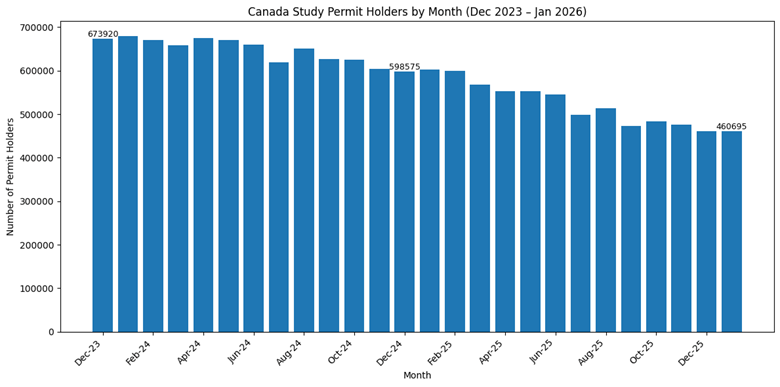
Canada had 673,920 people holding only a study permit in December 2023. By January 2026, that number had fallen to 460,695.
This represents a significant drop of more than 200,000 permit holders over two years.
The decline has not been linear, but the overall trend is clear:
- Early 2024 levels remained relatively stable, peaking at 679,685 in January 2024
- Numbers began to fall mid-2024, with sharper declines from summer onwards
- The steepest drops came in 2025, particularly between March and July
- By late 2025, totals consistently fell below 500,000
Monthly Breakdown of Study Permit Holders
Study Permit Caps Driving the Decline
The drop aligns with federal efforts to limit the number of international students entering Canada.
Under Carney’s government, Ottawa has moved to:
- Introduce caps on study permits
- Tighten eligibility requirements
- Increase scrutiny on designated learning institutions
- Link student intake more closely to housing and labour market capacity
These measures aim to reduce pressure on housing, infrastructure and public services.
A Structural Shift, Not a Temporary Dip
The data suggests the decline is not a short-term fluctuation.
Instead, it reflects a deliberate policy shift towards:
- Lower temporary resident volumes
- More controlled growth in international education
- Better alignment with long-term immigration targets
This is consistent with Canada’s broader immigration plan, which also includes reductions in temporary workers and students while maintaining stable permanent resident targets.
What It Means for Immigration and the Economy
International students have long played a key role in Canada’s immigration system and economy.
They contribute through:
- Tuition fees and consumer spending
- Filling labour shortages during and after studies
- Transitioning to permanent residence through programs like Express Entry
A sustained decline could have several impacts:
- Reduced revenues for colleges and universities
- Fewer candidates in future permanent residence pools
- Potential easing of housing demand in major cities
However, policymakers appear willing to accept these trade-offs in favour of a more sustainable system.
New Phase of Managed Migration
Canada’s international student numbers are falling sharply, and the trend shows no sign of reversing in the short term.
With study permit caps now in place, the country is entering a new phase of managed migration – one that prioritises balance over rapid growth.
FAQ
Why are international student numbers declining in Canada?
The decline is largely due to new federal policies that cap study permits and tighten eligibility rules. These changes aim to reduce pressure on housing and public services, while ensuring student intake aligns better with Canada’s economic and infrastructure capacity.
How significant is the drop in study permit holders?
The number fell from 673,920 in December 2023 to 460,695 in January 2026. This represents a drop of over 200,000 permit holders, with the steepest declines occurring throughout 2025 as policy changes took full effect.
What are study permit caps?
Study permit caps limit the number of new international students allowed into Canada each year. The government allocates quotas to provinces and institutions, reducing overall intake to better manage housing, infrastructure and labour market pressures.
Will this affect pathways to permanent residence?
Yes. Fewer international students means fewer candidates transitioning to permanent residence through programs like Express Entry. Over time, this could reduce the pool of candidates with Canadian education and work experience.
Is Canada still a good destination for international students?
Canada remains a strong option, but the system is becoming more selective. Students who meet higher standards and choose recognised institutions are still well positioned to benefit from education and potential immigration pathways.