
On this page you will find
- Key insights from Canada’s January 2026 jobs report
- Which sectors are growing and which are easing
- Where immigrants have the best chances of finding work
- Wage trends across the labour market
- What the data means for newcomers
Canada’s latest labour market data offers a clear message for newcomers – opportunities remain strong, but success increasingly depends on targeting the right sectors and locations.
The January 2026 figures show there were 492,400 job vacancies across the country, a level that continues to reflect solid underlying demand for workers despite a more balanced labour market than in recent years.
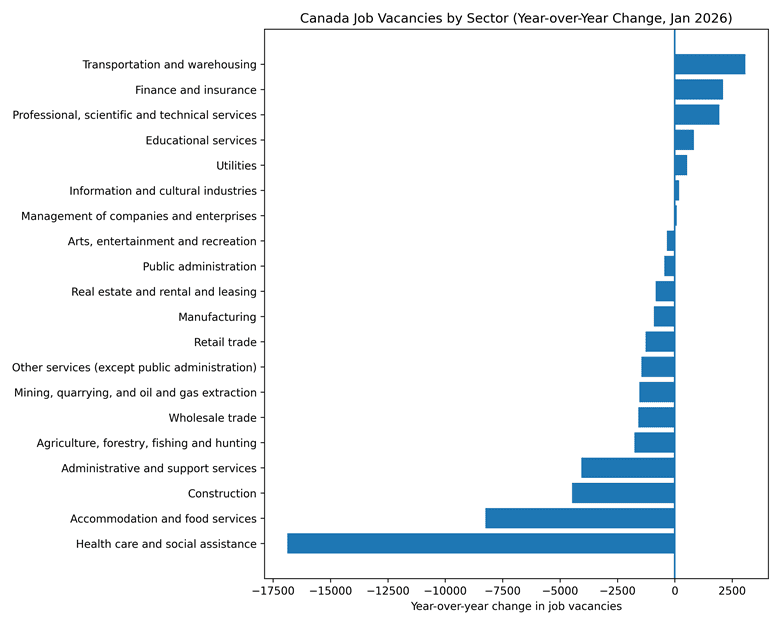
Chart: Job Vacancies by Sector (Change Over the Past Year)
A Labour Market That Is Stabilising – Not Weakening
For much of the post-pandemic period, Canada faced acute labour shortages. Employers across sectors struggled to fill roles, driving vacancy levels sharply higher. That phase is now easing.
The latest figures suggest a market that is stabilising rather than declining. There are still hundreds of thousands of open roles, but the pace of hiring has cooled. At the same time, the number of job seekers per vacancy has edged higher, meaning newcomers must be more strategic in their job search.
In practical terms, this shift rewards candidates who arrive with in-demand skills, relevant experience and a clear understanding of where opportunities are concentrated.
Growth Is Concentrated in Fewer, Higher-Value Sectors
The sector breakdown shows a more selective hiring environment. Rather than broad-based demand, growth is now concentrated in a smaller group of industries.
Transportation and warehousing stands out as the strongest area for new openings, reflecting continued demand linked to supply chains, logistics and e-commerce. Finance and insurance is another clear bright spot, with rising demand for roles tied to credit, lending and financial services. Professional, scientific and technical services also continues to expand, signalling ongoing demand for skilled, knowledge-based work.
For immigrants, this shift is significant. These sectors tend to align closely with economic immigration pathways such as Express Entry, where candidates are selected based on skills, education and work experience.
Declines Reflect Normalisation After Peak Demand
At the same time, several sectors are reporting fewer openings than a year ago, most notably health care, hospitality and administrative services.
This does not point to a collapse in demand. Instead, it reflects a cooling after an extended period of unusually high hiring. Health care, for example, saw intense recruitment pressures during and after the pandemic. The current decline in vacancies suggests that some of those immediate gaps have been filled, even as long-term demand remains.
A similar pattern is visible in accommodation and food services. Employers are still hiring, but not at the same pace seen during earlier labour shortages.
For newcomers, the takeaway is that these sectors remain viable entry points, but competition is increasing compared with recent years.
Geography Is Becoming a Deciding Factor
Where immigrants choose to settle is becoming more important.
The data shows that job openings have declined in Canada’s largest provinces, including Ontario, Quebec and British Columbia. These regions continue to offer the largest number of jobs overall, but they also attract the highest number of applicants.
By contrast, smaller provinces are showing more favourable conditions. In places such as Saskatchewan, there are significantly fewer job seekers competing for each available role. New Brunswick is also seeing growth in job openings.
This dynamic reinforces a long-standing trend in Canadian immigration policy. Both federal and provincial programs are increasingly designed to encourage newcomers to settle outside the largest urban centres, where labour shortages are often more acute.
Wage Growth Supports Long-Term Settlement
Alongside job availability, earnings remain an important consideration for newcomers. The latest data shows average weekly earnings have reached $1,320, with modest growth over the past year.
While wage increases are not rapid, they are steady, helping to support financial stability for new arrivals as they establish themselves in the workforce.
A More Strategic Approach to Finding Work
Taken together, the January 2026 jobs report points to a labour market that is still open to immigrants, but less forgiving than in the immediate post-pandemic period.
Opportunities remain widely available, particularly for skilled workers in sectors such as finance, logistics and professional services. However, success now depends more heavily on preparation, sector alignment and geographic flexibility.
For newcomers, this means approaching the Canadian job market with a clear plan. Those who match their skills to current demand and remain open to opportunities beyond the largest cities will be best positioned to succeed.
FAQ
What does the latest Canada jobs report mean for immigrants?
The report shows that Canada still has a large number of job openings, but the market is becoming more competitive. Immigrants who target in-demand sectors and remain flexible about location will have the best chances of finding work quickly.
Which sectors offer the best opportunities right now?
Transportation, finance and professional services are showing the strongest growth in job openings. These sectors often require skilled workers, making them a good match for candidates applying through Canada’s economic immigration programs.
Are there fewer jobs available than before?
There are slightly fewer openings than last year, but the overall number remains high. The change reflects a more balanced labour market rather than a drop in demand, meaning opportunities are still widely available.
Should immigrants avoid large provinces like Ontario?
Not necessarily. Large provinces still offer many opportunities, but they also attract more job seekers. Smaller provinces may provide better chances of finding work more quickly due to lower competition.
How much can newcomers expect to earn in Canada?
Average weekly earnings are about $1,320, with steady growth. Actual salaries vary depending on the sector, experience and location, but overall wage trends remain positive for newcomers entering the workforce.