



On This Page You Will Find
- Why Canada’s international student system grew rapidly
- Key policy decisions that drove the surge
- Evidence of system weaknesses and abuse
- Impact on housing and public services
- Details of the 2024 study permit cap
- What the future holds for international students
Canada’s international student system expanded at a pace that policymakers now openly acknowledge was unsustainable, according to a major new parliamentary report that lays bare the scale of growth and the policy failures behind it.
The report, “Reconstituting Canada’s International Student Program” , sets out a stark conclusion. For years, Canada allowed international student numbers to surge without meaningful limits, creating pressures across housing, public services and the labour market, while exposing weaknesses in how the system was managed.
A Decade of Rapid Growth
The numbers alone tell the story. Canada issued 222,000 new study permits in 2015. By 2019, that figure had risen to 404,000. By 2023, it had reached 684,000.
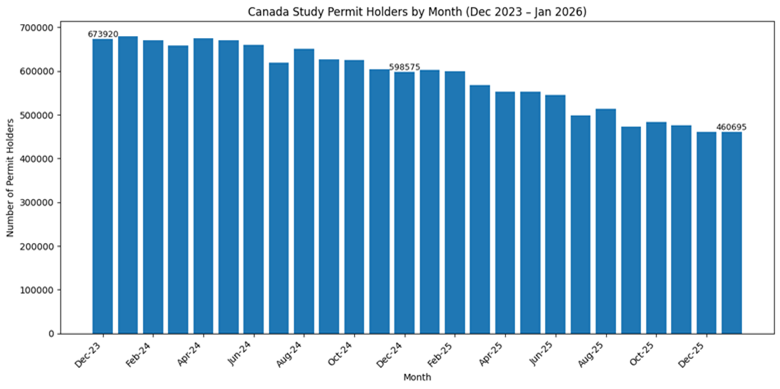
Over the same period, the total number of international students in Canada climbed to nearly one million, before exceeding that level in 2024. The report makes clear that this growth was not accidental. It was the result of a system that processed applications as they arrived, with no cap and no mechanism to align intake with housing capacity, labour needs or long-term immigration planning.
Officials described the pre-2024 model as demand-driven. In practice, that meant anyone who met eligibility requirements could enter the system, with overall volumes limited only by processing capacity rather than policy intent.
Policy Choices Drove the Surge
The report highlights how federal and provincial policies combined to fuel the expansion.
At the federal level, Canada actively promoted international education as both an economic driver and an immigration pathway. The country’s International Education Strategy aimed to dramatically increase student numbers, and it succeeded earlier than expected. By 2017, Canada had already surpassed its original target.
At the same time, immigration policies made Canada one of the most attractive destinations globally. International students were allowed to work during their studies, access post-graduation work permits and, in some cases, transition to permanent residence.
The report suggests this combination created powerful incentives. Canada was not just selling education. It was implicitly offering a pathway to long-term settlement, even though permanent residence spaces were far more limited than the number of students entering the system.
Provincial policy also played a role. Reduced public funding for post-secondary institutions pushed many colleges and universities to rely more heavily on international student tuition. In some cases, institutions expanded recruitment aggressively to offset financial pressures.
A System Vulnerable to Abuse
The report identifies structural weaknesses that allowed parts of the system to be exploited.
Some institutions and recruitment agents prioritised volume over quality, enrolling large numbers of students into programs with limited labour market value. Business programs in particular became a major driver of growth due to their relatively low cost and high profitability.
At the same time, international recruitment networks expanded rapidly. In some cases, these networks issued misleading information or even fraudulent documentation, including fake letters of acceptance. Students affected by these practices often arrived in Canada only to discover they were not properly enrolled.
The report also highlights how pathways to permanent residence were used as a marketing tool. While these pathways existed, they were never designed to accommodate the scale of international student intake that developed in the years leading up to 2024.
Pressure on Housing and Services
The rapid increase in international students coincided with growing pressure on housing markets, particularly in major urban centres.
The report points to evidence that the influx contributed to rising rents and overcrowding in some regions. In extreme cases, students reported living in highly congested conditions or falling victim to housing scams.
At the same time, broader demographic growth added to strain on healthcare systems and contributed to higher youth unemployment in certain areas. The report emphasises that international students were not the sole cause of these pressures, but they formed a significant part of a wider surge in temporary residents.
The 2024 Turning Point
The federal government’s response came in January 2024 with the introduction of a cap on study permit applications. For the first time, Canada set a limit on the number of international students it would admit each year.
The cap represented a major shift in approach. Instead of allowing demand to dictate intake, the government moved to actively manage volumes. Targets were reduced year over year, with the aim of stabilising and then lowering the overall number of international students in Canada.
The reforms went beyond caps. The government increased financial requirements for students, tightened eligibility for post-graduation work permits and introduced stricter compliance rules for institutions. It also required provinces to play a more direct role in allocating study permit spaces through attestation letters.
Early Signs of Impact
Initial data suggests the reforms are having a significant effect.
The number of study permits issued fell sharply after 2023. By 2024, the total had dropped to 517,000, with fewer new students entering the country. By 2025, arrivals had declined even further.
The overall number of international students has also begun to fall, reversing years of uninterrupted growth. According to the report, this decline has already eased pressure in some housing markets, with rental price growth slowing in regions that had seen particularly high student populations.
However, the report cautions that the full impact of the reforms will take time to assess. Policymakers are still balancing competing objectives, including maintaining Canada’s attractiveness to international students while addressing domestic pressures.
A Shift Toward a Smaller System
The report’s central recommendation is clear. Canada should move toward a smaller, more controlled international student system that prioritises quality, integrity and alignment with national needs.
That means stronger oversight of institutions, better coordination between federal and provincial governments and clearer communication to prospective students about what studying in Canada can realistically offer.
The era of rapid, largely unmanaged growth appears to be over. In its place, Canada is attempting to build a system that is more sustainable, but also more selective.
For prospective international students, the message is changing. Canada remains open, but the pathway is no longer as broad or as predictable as it once appeared.
FAQ
Why does the report say Canada lost control of international students?
The report concludes that Canada allowed study permit numbers to grow without limits for years. Applications were processed as they arrived, with no cap in place, leading to a rapid increase that policymakers now describe as unsustainable.
How fast did international student numbers grow in Canada?
Growth was significant over a short period. Study permits rose from 222,000 in 2015 to 684,000 in 2023. At the same time, the total number of international students reached nearly one million, before exceeding that level in 2024.
What caused the surge in international students?
The report points to a combination of federal immigration policies, provincial funding pressures on institutions and aggressive recruitment practices. Together, these factors encouraged rapid expansion without sufficient oversight or long-term planning.
What changes did Canada introduce in 2024?
Canada introduced a cap on study permit applications for the first time. It also increased financial requirements, tightened post-graduation work permit rules and introduced stronger compliance measures for institutions and applicants.
What does this mean for future international students?
Canada is moving toward a smaller and more controlled system. While opportunities remain, the pathway is more competitive and less predictable. Students need stronger profiles and should not assume studying in Canada will lead to permanent residence.