On this page you will find
- A breakdown of declining temporary worker arrivals
- Key trends across TFW and IMP programs
- What is driving the drop in numbers
- Seasonal patterns and what they show
- What it means for employers and immigrants
Canada has sharply reduced the number of new temporary workers entering the country, with arrivals across key programs falling by more than half since early 2024. The latest federal data points to a clear and sustained policy shift aimed at tightening temporary immigration levels.
A steep decline across both major worker streams
The data shows a dramatic fall in arrivals under both the Temporary Foreign Worker Program and the International Mobility Program.
In January 2024, Canada welcomed 6,525 temporary foreign workers. By January 2026, that number had dropped to just 2,675. This represents a decline of nearly 60 per cent.
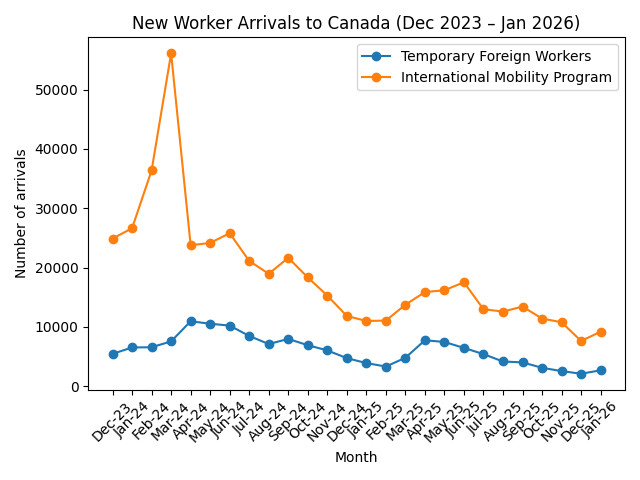
The International Mobility Program has seen an even sharper contraction. Monthly arrivals fell from 26,620 in January 2024 to 9,175 in January 2026, a drop of roughly 65 per cent.
The trend is consistent across the full period. While early 2024 saw strong inflows, particularly during the spring months, numbers declined steadily through late 2024 and fell further throughout 2025.
2024 peak followed by sustained tightening
The first half of 2024 now appears to mark a high point before policy changes took effect.
In March 2024, International Mobility Program arrivals surged to more than 56,000, likely reflecting a combination of seasonal demand and backlog processing. Temporary foreign worker numbers also peaked in April and May 2024 at more than 10,000 per month.
From mid-2024 onwards, however, arrivals began to fall. By late 2025, monthly totals had dropped to around 2,000 to 3,000 for temporary foreign workers and between 7,000 and 11,000 for mobility program participants.
This suggests Canada has moved deliberately to reduce inflows rather than experiencing a short-term fluctuation.
A new lower baseline for temporary immigration
By the end of 2025, both programs appear to have stabilised at significantly lower levels.
Temporary foreign worker arrivals, which regularly exceeded 10,000 per month in early 2024, are now closer to 2,000 to 3,000. International Mobility Program arrivals have similarly settled well below previous norms.
The seasonal pattern remains visible, with modest increases in spring and summer, but the overall ceiling has dropped considerably. This points to a structural reset in how many temporary workers Canada is prepared to admit.
Policy shift driving the decline
The drop aligns closely with federal efforts to bring down the number of temporary residents in Canada.
Ottawa has signalled a move towards more controlled and sustainable immigration levels, with particular focus on reducing pressure on housing, infrastructure and public services.
Measures introduced since 2024 have included tighter rules for employers hiring through the Temporary Foreign Worker Program, as well as broader efforts to limit the growth of temporary resident populations.
The data suggests these policies are now having a measurable impact on arrivals.
What it means for employers and immigrants
For employers, the decline in arrivals is likely to increase competition for labour, particularly in sectors that rely heavily on temporary foreign workers. Businesses may face greater challenges filling roles, especially during peak seasonal periods.
For prospective immigrants, the trend signals fewer entry pathways through temporary work. As a result, programs such as provincial nominee streams and permanent residence pathways may become more important.
The figures also underline a broader shift in Canada’s immigration strategy. After years of expansion, the focus is now on managing volumes more tightly.
A turning point in Canada’s immigration approach
The sustained decline in temporary worker arrivals marks a significant turning point. Canada is no longer increasing inflows to meet labour demand at any cost. Instead, it is actively reducing numbers to align with wider economic and social priorities.
If current trends continue, the lower baseline seen in late 2025 and early 2026 may represent the new normal for temporary immigration to Canada.
FAQ
Why are temporary worker arrivals to Canada declining?
Canada is actively reducing the number of temporary residents to ease pressure on housing and services. Policy changes since 2024 have tightened access to work permits and limited employer use of foreign labour, leading to a sustained drop in arrivals.
What is the difference between TFW and IMP programs?
The Temporary Foreign Worker Program requires employers to obtain a labour market impact assessment. The International Mobility Program allows hiring without this step in certain cases, such as intra-company transfers or international agreements.
Was the drop in numbers sudden or gradual?
The decline has been gradual but consistent. After strong inflows in early 2024, numbers fell through late 2024 and dropped further in 2025, indicating a deliberate policy-driven reduction rather than a short-term fluctuation.
Does seasonality still affect worker arrivals?
Yes, seasonal patterns remain, with higher arrivals in spring and summer. However, overall volumes are significantly lower than in previous years, suggesting a reduced ceiling rather than a change in timing.
What does this mean for future immigrants?
Fewer temporary work opportunities may make it harder to enter Canada through work permits. This could increase competition and shift focus towards permanent residence pathways such as Express Entry and provincial nominee programs.