



On this page you will find:
- How long it takes immigrants to find a job in Canada
- Why some newcomers find work faster
- The main barriers facing new arrivals
- Differences between immigrants and non-permanent residents
- What the data means for newcomers
Faster Job Entry for Newcomers
New immigrants to Canada are finding their first job more quickly than previous cohorts, according to new data from Statistics Canada.
Among recent working-age immigrants who did not have a job lined up before arriving, 42.5% found their first job or started a business within three months. This marks a clear improvement compared with earlier cohorts, reflecting a labour market shaped by post-pandemic worker shortages.
The data suggests that newcomers are entering the workforce faster than before. However, the headline improvement masks a more complex reality.
The Timeline: How Long It Takes to Find a First Job
The job search experience for newcomers still varies widely.
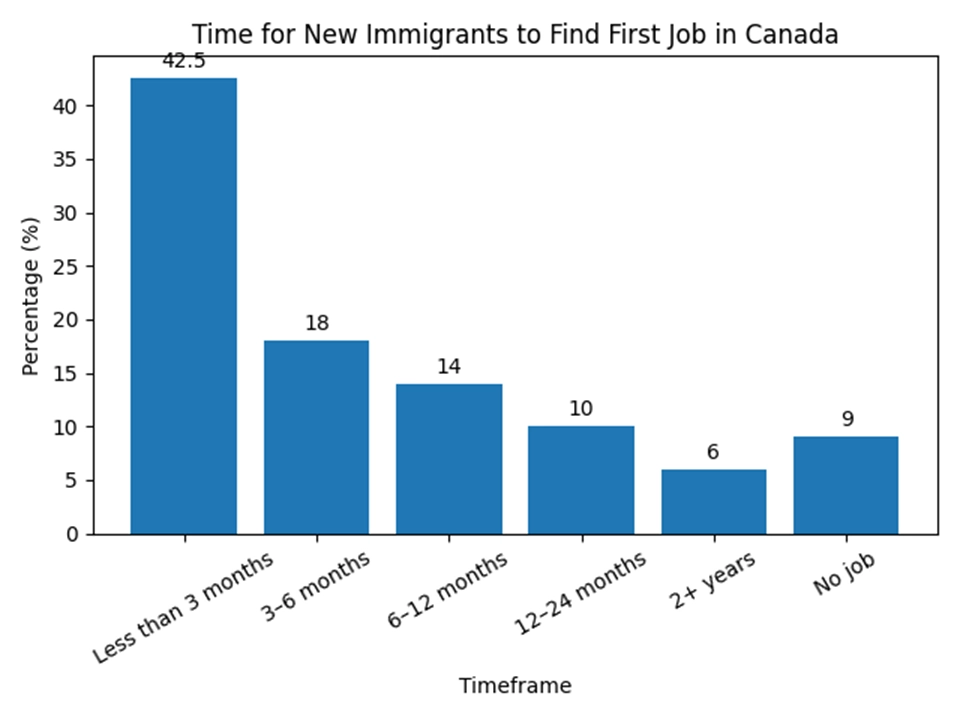
Recent immigrants are more likely than those who arrived 10 to 15 years ago to find work within three months, highlighting improved early integration.
This shift reflects stronger hiring demand during the post-COVID recovery, when employers faced record vacancies across multiple sectors.
Why Some Newcomers Find Jobs Quickly
Several factors are driving faster entry into the labour market.
First, Canada’s labour shortages in the years following COVID-19 created favourable conditions for hiring. Employers were more willing to consider candidates without Canadian experience.
Second, many newcomers arrive job-ready. Over 80% of recent immigrants with postsecondary qualifications already had relevant work experience before coming to Canada.
Third, a growing number of newcomers enter Canada through “two-step” pathways. These individuals gain Canadian work experience as non-permanent residents before becoming permanent residents, improving their job prospects.
Non-permanent residents also show strong early outcomes. Nearly half (48.5%) of those without a pre-arranged job found work within three months, while 20.3% had already secured employment before arriving.
Fast Entry Doesn’t Mean Easy Entry
Despite faster job access, many newcomers still face significant barriers.
About 31.7% of recent immigrants reported difficulties finding their first job or starting a business.
The most common challenges include:
- Lack of Canadian work experience or references – 42.2%
- Limited professional networks – 38.3%
- Language-related barriers – 32.2%
- Foreign qualifications not recognised – 31.9%
These challenges have persisted across multiple immigrant cohorts, suggesting structural issues in how newcomers integrate into the labour market.
Before Arrival vs After Arrival Jobs
The pathway into employment also differs depending on immigration status.
Only 11% of recent immigrants secured a job before arriving in Canada. In contrast, more than one in five non-permanent residents had employment arranged in advance.
This reflects the design of many temporary work programs, which are often employer-driven and require a job offer. It also explains why non-permanent residents tend to enter the workforce more quickly.
What Happens After the First Job?
Finding a job quickly does not necessarily mean long-term success.
The employment rate for recent immigrants stood at 75.5%, compared with 85.4% for people born in Canada.
Wage gaps also remain significant. Recent immigrants earned 23.7% less on average than Canadian-born workers, while non-permanent residents earned 33.4% less.
Many newcomers also struggle to work in their field. While more recent immigrants are finding jobs related to their qualifications than previous cohorts, a large proportion still experience skills mismatch.
What This Means for New Immigrants
The data offers a realistic picture for prospective newcomers.
- Many immigrants can expect to find work within three months – but not all
- Canadian experience remains a key barrier
- Networking plays a major role in job success
- Credential recognition should be planned early
Faster job entry is a positive sign, but it does not eliminate the need for preparation.
A Trend That May Not Last
The improved timeline for finding a first job is closely linked to recent labour shortages.
As Canada moves to reduce temporary resident numbers and labour market conditions stabilise, job search timelines could lengthen again. The current data may represent a high point rather than a new baseline.
FAQ
How long does it take immigrants to find a job in Canada?
Around 42.5% of recent immigrants who did not have a job before arrival found work within three months. However, timelines vary widely, and some newcomers take six months or longer depending on their field, experience and job search strategy.
Why do some newcomers find jobs faster than others?
Faster outcomes are linked to strong labour demand, prior work experience, and having a job offer before arrival. Non-permanent residents often enter the workforce more quickly because their visas are tied to specific employers or job opportunities.
What are the biggest challenges immigrants face when job hunting?
The main barriers include lack of Canadian experience, limited professional networks, language difficulties, and challenges with recognising foreign credentials. These issues continue to affect a significant share of newcomers despite improvements in hiring timelines.
Can immigrants get a job before arriving in Canada?
Yes, but it is less common for permanent residents. About 11% of recent immigrants had a job before arrival, compared with over 20% of non-permanent residents, whose entry pathways are often employer-driven.
Are immigrants working in their field in Canada?
Not always. While more recent immigrants are finding jobs related to their qualifications, many still experience skills mismatch. Credential recognition and licensing requirements in regulated occupations remain key barriers to working in their trained profession.