



On this page you will find
- Why Canada’s population fell in the fourth quarter of 2025
- How temporary residents drove the decline
- What the latest figures say about permanent immigration
- Which provinces saw the biggest losses and gains
- Why Alberta continued to attract interprovincial migrants
- Why Statistics Canada says the estimates could still change
Canada’s population slipped in the fourth quarter of 2025
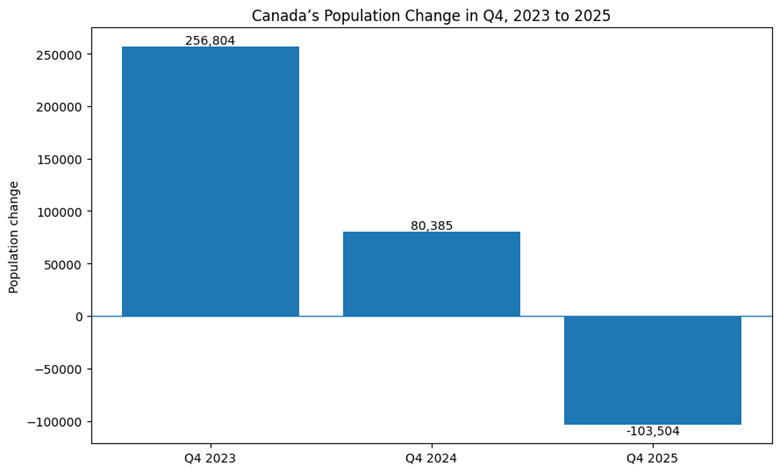
Statistics Canada says Canada’s population stood at 41,472,081 on January 1, 2026, down by 103,504 people from October 1, 2025 to January 1, 2026. That amounts to a quarterly decrease of 0.2 per cent and marks a sharp slowdown compared with the same period in the previous two years.
The decline stands out because Canada had still posted population growth of 80,385 in the fourth quarter of 2024 and 256,804 in the fourth quarter of 2023. In other words, the country moved from strong late-year growth to an outright population decline in just two years.
For immigration watchers, the key reason is clear. The biggest factor behind the slowdown was a large drop in the number of temporary residents, even as Canada continued to welcome permanent immigrants.
Fewer temporary residents drove the slowdown
From October 1, 2025 to January 1, 2026, the number of temporary residents in Canada fell by 171,296. Statistics Canada said all provinces and Yukon recorded a decline in their temporary resident population during the quarter.
After peaking at 3,149,131 on October 1, 2024, the number of temporary residents had fallen to 2,676,441 by January 1, 2026. The decline mainly reflected lower numbers of people holding only a study permit, only a work permit, or both a work and study permit.
That matters because temporary residents had been a major driver of Canada’s recent population growth. As their numbers fell, the overall pace of population increase weakened sharply and then turned negative.
However, Statistics Canada also warned that the picture may change. The agency said recent policy changes and growing numbers of work and study permit extensions may not yet be fully captured in the preliminary estimates. That means the current figures for 2025 and early 2026 could still be revised in the coming months.
Permanent immigration remained the only source of growth
Canada welcomed 83,168 permanent immigrants in the fourth quarter of 2025. That was down 19.6 per cent from 103,438 in the same quarter of 2024.
Even so, permanent immigration remained the only positive component of population growth in the quarter. Natural increase was negative at -781, meaning Canada recorded more deaths than births over the period. Without new permanent residents, the overall population decline would have been larger.
This is an important point in the current immigration debate. While Ottawa has acted to reduce temporary resident numbers and slow overall population growth, permanent immigration continued to provide the main buffer against deeper demographic decline.
Statistics Canada said the lower number of new permanent immigrants in late 2025 was still in line with Immigration, Refugees and Citizenship Canada’s target for the 2025 calendar year.
Ontario stayed the top destination for new immigrants
Ontario remained Canada’s leading destination for permanent immigrants in the fourth quarter of 2025. The province welcomed 35,159 new permanent residents, representing 42.3 per cent of all immigrants admitted during the quarter.
Quebec was the only province to record an increase in new permanent immigrants compared with the same quarter in 2024. It welcomed 13,361 immigrants in the fourth quarter of 2025, up from 12,496 a year earlier.
All other provinces and Yukon saw fewer new immigrants than they did in the final quarter of 2024. That suggests the slowdown in permanent immigration was felt almost everywhere, even if the broader annual targets remained on track.
Alberta kept attracting Canadians from other provinces
At the same time, Alberta continued to dominate interprovincial migration. It recorded a net gain of 3,684 people from migratory exchanges with other provinces and territories in the fourth quarter of 2025.
That made it the 14th consecutive quarter in which Alberta posted the largest net interprovincial gain in Canada. British Columbia, with a gain of 1,227, and Nova Scotia, with 826, were the only other jurisdictions to post net gains.
Ontario and Quebec both posted losses. Ontario lost 1,598 people through interprovincial migration, while Quebec lost 1,579.
These figures underline a broader trend in Canadian migration patterns. Even as international migration slows, internal migration continues to reshape where people choose to live, with Alberta remaining the biggest winner.
Several provinces recorded population declines
Statistics Canada said British Columbia posted the steepest quarterly population decline at -0.4 per cent. Prince Edward Island, Quebec and Ontario each recorded declines of -0.3 per cent.
By contrast, Alberta was the only province or territory with the fastest positive growth rate, at +0.1 per cent.
For policymakers, these regional differences matter. They show that the national slowdown is not hitting every part of the country in the same way. Provinces that relied heavily on temporary residents or lost people to other provinces felt the pressure more sharply.
Canada’s population also declined over the full year
The slowdown was not limited to one quarter. Over the full 2025 calendar year, Canada’s population fell by 102,436 people, or 0.2 per cent, according to the preliminary estimates.
Statistics Canada said population growth had already begun to slow early in the year. The gain recorded in the first half of 2025, at 77,136, was not enough to offset losses in the second half of the year, which totalled 179,572.
The third quarter saw a population drop of 76,068, followed by the fourth-quarter drop of 103,504.
Still, Statistics Canada urged caution. Because more complete administrative data will be incorporated later, the final estimates may show a smaller decline, a larger one, or even a return to growth. The agency specifically pointed to permit extensions and recent immigration policy changes as factors that could materially alter the final numbers.
What this means for immigration policy
The latest figures offer one of the clearest signs yet that Canada’s efforts to curb rapid population growth are having an effect. The decline in temporary residents shows how changes to temporary migration streams can quickly influence national population trends.
At the same time, the figures also show how central permanent immigration remains to Canada’s demographic outlook. With natural increase now negative, permanent residents helped limit the overall population decline.
That creates a delicate policy balance. Ottawa is under pressure to ease strain on housing, infrastructure and public services, but Canada still needs immigration to support long-term labour force growth and offset an ageing population.
The fourth quarter of 2025 may therefore mark an important turning point. It suggests Canada is entering a new phase in which tighter temporary migration rules slow population growth, while permanent immigration remains essential to economic and demographic stability.
FAQ
Why did Canada’s population fall in the fourth quarter of 2025?
Canada’s population fell mainly because the number of temporary residents dropped sharply. Statistics Canada estimated a decline of 171,296 temporary residents during the quarter. Although permanent immigration remained positive, it was not enough to offset those losses and the country’s negative natural increase.
How many permanent immigrants did Canada welcome in late 2025?
Canada welcomed 83,168 permanent immigrants in the fourth quarter of 2025. That was lower than the 103,438 admitted in the same quarter of 2024, but Statistics Canada said it was still in line with IRCC’s target for the 2025 calendar year.
What happened to temporary resident numbers in Canada?
The number of temporary residents fell from 3,149,131 on October 1, 2024 to 2,676,441 on January 1, 2026. The fourth-quarter 2025 decline was mainly linked to lower numbers of study permit holders, work permit holders, and people holding both types of permits.
Which province attracted the most immigrants in the fourth quarter of 2025?
Ontario remained the top destination for new permanent immigrants. It welcomed 35,159 people in the fourth quarter of 2025, accounting for 42.3 per cent of all new permanent immigrants to Canada. Quebec was the only province to see year-over-year growth in new immigrant arrivals.
Could these population estimates still change?
Yes. Statistics Canada says these are preliminary estimates and may be revised as more complete administrative data becomes available. The agency noted that recent work and study permit extensions, as well as new policy measures, could lead to larger-than-usual updates for 2025 and 2026 figures.