



Canada has entered a clear period of contraction in international student and temporary worker inflows. New federal data shows sustained and sharp declines through 2024 and 2025, reflecting deliberate policy choices to bring temporary migration back to what the government describes as sustainable levels.
The shift forms part of the federal Immigration Levels Plan and is being overseen by Immigration, Refugees and Citizenship Canada, which has committed to reducing the country’s temporary resident population to below five per cent of the total population. The stated aim is to ease pressure on housing, infrastructure and public services while refocusing opportunities on people already in Canada.
On This Page You Will Find
- Why Canada is reducing student and temporary worker inflows
- Monthly data showing declining arrivals in 2024 and 2025
- How international student numbers have changed
- The impact of reforms on temporary worker arrivals
- What the trends mean for Canada’s immigration system
A sustained fall in new arrivals
The most striking trend in the data is the scale and consistency of the decline. Between January and November 2025, Canada recorded 52 per cent fewer combined arrivals of international students and temporary workers compared with the same period in 2024. That represents 334,845 fewer people entering the country on study or work permits.
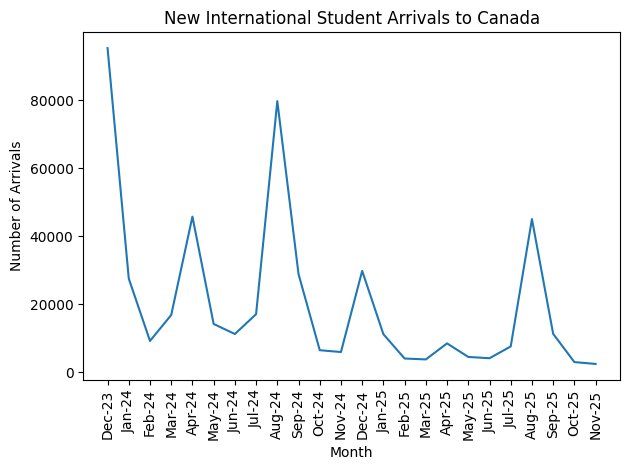
Monthly figures show that the traditional seasonal spikes remain, particularly in August and December for students, but at much lower levels than in previous years. Outside these peak months, arrival volumes have dropped to historically low levels.
By November 2025, Canada recorded just 2,485 new international student arrivals and 13,365 new temporary worker arrivals, numbers that would have been unthinkable only two years earlier.
International student arrivals fall sharply
International student inflows have contracted more steeply than any other temporary category. Between January and November 2025, Canada admitted 60 per cent fewer new students than during the same period in 2024, a reduction of 157,380 arrivals.
The data reflects the impact of several policy changes. Ottawa introduced an annual cap on study permits in 2024 and announced further reductions for 2025 and 2026. At the same time, it tightened oversight of acceptance letters to combat fraud and raised financial requirements to ensure students arrive better prepared to support themselves.
Seasonal surges remain visible, particularly in August ahead of the fall semester, but even those peaks are now well below previous norms. August 2025 saw 45,065 new student arrivals, compared with nearly 80,000 in August 2024 and more than 95,000 in December 2023.
Temporary worker inflows also retreat
Temporary worker arrivals have followed a similar downward trajectory, although the decline has been slightly less abrupt than in the student stream. Between January and November 2025, Canada admitted 47 per cent fewer new temporary workers than in the same months of 2024, a drop of 177,465 arrivals.
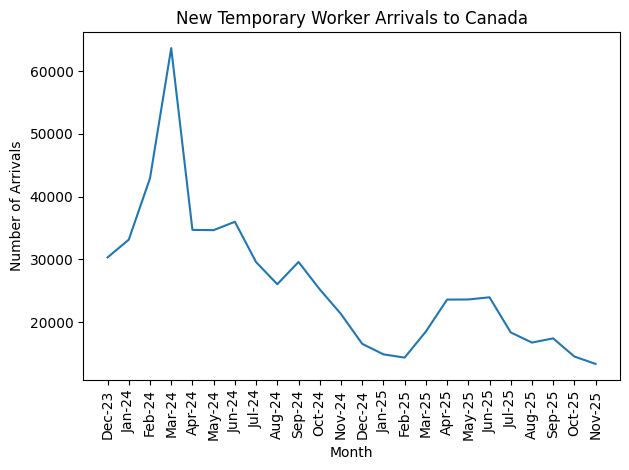
This trend reflects multiple overlapping reforms. The federal government imposed a 10 per cent cap on low-wage hiring under the Temporary Foreign Worker Program, with limited sectoral exceptions. It also stopped processing low-wage applications in metropolitan areas with unemployment of six per cent or higher.
Changes to the Post-Graduation Work Permit program narrowed eligibility, while new restrictions limited open work permits for spouses of international students and temporary foreign workers. At the same time, Canada accelerated permanent residence pathways for select in-demand workers already in the country.
What the total numbers show
While new arrivals have fallen sharply, the total number of temporary residents in Canada has declined more gradually. This reflects processing backlogs and the fact that many permits were issued under earlier rules and remain valid.
As of November 30, 2025, Canada had 476,330 people holding only a study permit, down from more than 670,000 at the start of 2024. The number of people holding both a study and work permit also declined significantly, falling to 244,900.
The picture for work permit holders is more stable. Canada recorded 1,491,500 people holding only a work permit as of November 2025, a slight decline from mid-2025 but still well above 2023 levels. This reflects the longer validity of many work permits and the continued processing of applications already in the system.
Turning temporary residents into permanent ones
Alongside reducing inflows, Canada has placed renewed emphasis on transitioning temporary residents to permanent status. From January to November 2025, more than 177,000 former temporary residents became permanent residents, accounting for roughly 48 per cent of all new permanent admissions during that period.
These applicants tend to be well integrated, with Canadian education, Canadian work experience and proficiency in one or both official languages. Most apply through economic programs such as Express Entry and the Provincial Nominee Program, which align selection with labour market and regional needs.
The government has framed this approach as a way to preserve Canada’s ability to attract global talent while easing short-term pressures and restoring balance to the immigration system.
Frequently Asked Questions
Why is Canada reducing international student and temporary worker numbers?
The federal government says the reductions are needed to ease pressure on housing, infrastructure and public services. The goal is to bring the temporary resident population below five per cent while maintaining long-term economic growth.
How large is the decline in student arrivals?
Between January and November 2025, Canada admitted 60 per cent fewer international students than during the same period in 2024, representing more than 157,000 fewer arrivals.
Are seasonal student intakes still happening?
Yes. August and December still show seasonal spikes linked to academic calendars, but these peaks are now far smaller than in previous years due to study permit caps and tighter controls.
Why have temporary worker numbers fallen?
The decline reflects limits on low-wage hiring, tighter rules under the Temporary Foreign Worker Program, reforms to the Post-Graduation Work Permit program and restrictions on spousal work permits.
Is Canada still offering permanent residence to temporary residents?
Yes. In fact, nearly half of all new permanent residents in 2025 were former temporary residents, reflecting a policy focus on retaining people already working and studying in Canada.