



Canada’s Express Entry system in 2025 marked one of the most active and targeted years since the system launched in 2015. Immigration, Refugees and Citizenship Canada (IRCC) relied heavily on category-based draws, French-language proficiency, and Canadian Experience Class invitations to meet labour market and francophone objectives, while keeping Provincial Nominee Program (PNP) candidates at the top of the CRS scale.
This review explains how Express Entry operated in 2025, what the draw data shows, and what prospective applicants should understand going forward.
On This Page You Will Find
- How Express Entry operated in 2025 and why the system shifted
- A summary of IRCC’s key Express Entry changes in 2025
- Breakdown of Express Entry draw activity across the year
- Detailed analysis of Canadian Experience Class draws
- How French-language proficiency reshaped Express Entry outcomes
- Why Provincial Nominee Program draws remained the highest CRS pathway
- The role of healthcare and social services occupation draws
- Analysis of education and trade occupation draws
- CRS score trends across all Express Entry categories
- What Express Entry results in 2025 mean for applicants
- How Express Entry is expected to evolve in 2026
How Express Entry Worked in 2025
Express Entry continued to manage applications for permanent residence under three federal programs:
In addition, IRCC issued invitations through PNP-linked Express Entry streams and category-based draws introduced in 2023.
In 2025, IRCC prioritised applicants who already had Canadian work experience, French-language ability, or occupations aligned with critical labour shortages.
How the 2025 Immigration Levels Plan shaped Express Entry
Express Entry in 2025 operated under Canada’s 2025 Immigration Levels Plan, which set a target of 395,000 new permanent residents, with 232,150 places allocated to economic immigration.
The plan prioritised in-Canada transitions, directly influencing the high volume of Canadian Experience Class draws and the continued importance of Provincial Nominee Program invitations. It also set a clear target for francophone immigration outside Quebec of 8.5 per cent, driving the large and frequent French-language Express Entry draws with lower CRS cut-offs.
Together, these priorities explain why Express Entry in 2025 focused less on general competition and more on targeted, policy-driven selection.
Express Entry changes in 2025 – summary overview
Canada’s Express Entry system shifted noticeably in 2025. Immigration, Refugees and Citizenship Canada (IRCC) moved away from broad, general competition and relied more heavily on targeted selection tied to labour market and demographic priorities. As a result, eligibility and category alignment mattered more than raw CRS scores.
One of the most significant changes was the introduction of education occupations as a formal Express Entry category. Teachers, early childhood educators, and related professionals gained access to targeted draws, reflecting growing shortages across schools and childcare systems nationwide. Education joined healthcare as a priority occupation group rather than remaining a peripheral concern.
At the same time, IRCC narrowed several existing category lists. Many STEM, transport, and agriculture occupations that featured prominently in 2024 were removed from targeted draws in 2025. Candidates in these fields could still immigrate, but increasingly had to rely on Canadian Experience Class draws, general Express Entry rounds, or Provincial Nominee Programs.
Canadian work experience moved further to the centre of the system. Frequent Canadian Experience Class draws showed a clear preference for candidates already working in Canada, supporting labour market continuity and faster economic integration.
French-language proficiency remained one of the strongest advantages in Express Entry. IRCC continued to run large, high-volume French-language draws with lower CRS cut-offs, supporting the federal objective of increasing francophone immigration outside Quebec, including the 8.5 per cent target for French-speaking newcomers.
Overall, Express Entry in 2025 no longer functioned as a single competition. It operated as a set of parallel pathways, each with distinct eligibility rules, draw sizes, and CRS dynamics. This structural shift explains the wide variation in CRS cut-offs across categories and frames the detailed analysis that follows.
Overview of Express Entry Draw Activity in 2025
Between January and December 2025, IRCC conducted 58 Express Entry draws, issuing tens of thousands of Invitations to Apply (ITAs).
Key characteristics of 2025 draws included:
- High-frequency Canadian Experience Class draws, often with CRS scores between 510 and 534
- Large French-language proficiency draws with historically low CRS cut-offs, some below 400
- Consistent PNP draws with CRS scores typically above 700
- Targeted occupation draws focused on healthcare, social services, education, and trades
This structure allowed IRCC to balance economic demand, regional needs, and long-term demographic goals.
Canadian Experience Class draws in 2025
Canadian Experience Class (CEC) draws were one of IRCC’s main levers within Express Entry in 2025. Across the year, IRCC conducted 15 CEC draws, issuing 35,850 Invitations to Apply (ITAs). CRS cut-offs remained relatively tight compared with other draw types, ranging from 515 to 547, with an average of roughly 529. This consistency reflects IRCC’s steady reliance on candidates already working in Canada.
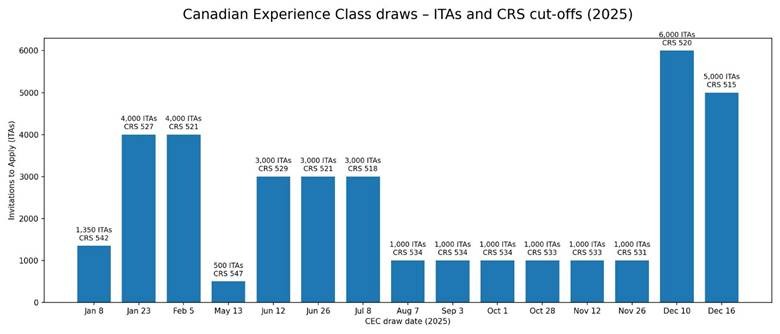
A year of two rhythms – pause, then surge
CEC invitations followed clear phases over the course of the year.
- Early-year activity (January – February)
IRCC held three CEC draws on January 8, January 23, and February 5, issuing 9,350 ITAs. CRS scores fell from 542 to 521, indicating a rapid increase in draw size after the first round of the year. - Spring pause and reset draw (May 13)
After February 5, CEC draws paused for nearly three months. The program returned on May 13 with a small draw of 500 ITAs at a CRS of 547, the highest CEC cut-off of 2025. This pattern is consistent with a limited intake following a prolonged gap. - Steady mid-year cadence (June – July)
Between June 12 and July 8, IRCC issued three draws in four weeks, delivering 9,000 ITAs. CRS scores eased from 529 to 521 to 518, creating the clearest example of higher volume paired with lower CRS thresholds. - Autumn stability (August – November)
From August 7 through November 26, CEC draws became highly predictable. Most rounds issued 1,000 ITAs, with CRS scores clustered between 531 and 534. Draws generally occurred every two to four weeks, offering in-Canada candidates a stable planning window. - Year-end push (December)
The year closed with two large CEC draws on December 10 and December 16, issuing 6,000 ITAs at CRS 520 and 5,000 ITAs at CRS 515, respectively. The final draw produced the lowest CEC CRS score of the year, reflecting a deliberate year-end intake surge.
What the CRS pattern suggests
The 2025 CEC data follows a familiar operational pattern:
- When IRCC issued larger numbers of ITAs, CRS scores generally declined.
- When IRCC limited invitations, CRS scores rose, with May 13 standing out as the clearest example.
This reflects simple supply and demand dynamics. Larger draws reach deeper into the Express Entry pool, while smaller draws remain concentrated near the top-ranked candidates.
CEC volume by quarter
CEC activity also shifted noticeably across the year:
- Q1 (January – March) – 3 draws, 9,350 ITAs, CRS 521 – 542
- Q2 (April – June) – 3 draws, 6,500 ITAs, CRS 521 – 547
- Q3 (July – September) – 3 draws, 5,000 ITAs, CRS 518 – 534
- Q4 (October – December) – 6 draws, 15,000 ITAs, CRS 515 – 534
The key takeaway is clear. CEC momentum accelerated sharply in Q4, both in the number of draws and in total invitations issued, reinforcing IRCC’s preference for transitioning temporary residents to permanent residence at year end.
French-language proficiency draws in 2025
French-language proficiency draws were one of the most distinctive and influential features of Express Entry in 2025. IRCC used these draws aggressively to advance francophone immigration objectives outside Quebec, issuing tens of thousands of Invitations to Apply at CRS levels well below those seen in other draw types.
Across the year, French-language draws consistently produced the lowest CRS cut-offs in Express Entry, fundamentally reshaping the competitiveness of the system for bilingual and francophone candidates.
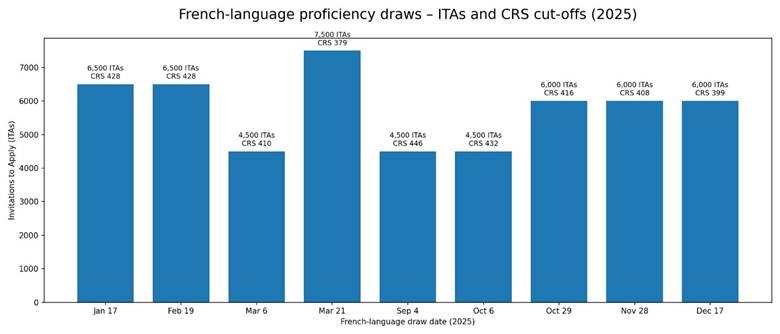
A high-volume, low-CRS strategy
Unlike Canadian Experience Class or PNP draws, French-language draws followed a clear and deliberate strategy: large invitation numbers paired with low CRS thresholds.
Key draws included:
- January and February momentum
Early in the year, IRCC issued large French-language draws, including 6,500 ITAs in February with a CRS cut-off of 428. These early rounds immediately set French-language draws apart from other categories. - March peak – the lowest CRS of the year
On March 21, IRCC issued 7,500 ITAs with a CRS cut-off of 379, the lowest score recorded in Express Entry in 2025. This draw alone accounted for a significant share of total French-language invitations and underscored the scale of IRCC’s francophone intake ambition. - Mid-year pause, then resumption
After March, French-language draws paused for several months before resuming in early autumn. When they returned, the underlying pattern remained unchanged: high volumes and accessible CRS scores. - Autumn and year-end consistency
Between September and December, IRCC conducted multiple French-language draws issuing 4,500 to 6,000 ITAs at CRS levels generally between 399 and 446. The final draw of the year, on December 17, issued 6,000 ITAs with a CRS cut-off of 399, closing the year near its lowest thresholds.
CRS behaviour in French-language draws
French-language CRS scores in 2025 were not only low, but also remarkably stable given the size of the draws.
Across the year, CRS cut-offs broadly ranged from 379 to the mid-440s, with most draws clustered in the low 400s. Unlike CEC draws, where CRS moved in a narrow competitive band, French-language draws consistently reached deep into the Express Entry pool.
This stability suggests that IRCC was less concerned with fine-tuning competitiveness and more focused on meeting clear intake targets for francophone immigration.
Why French-language draws behaved differently
The 2025 data strongly indicates that French-language draws were driven by policy objectives rather than pool pressure alone. These include:
- Meeting federal francophone immigration targets outside Quebec
- Supporting minority-language communities across provinces
- Diversifying the economic immigration intake beyond English-dominant profiles
As a result, French-language proficiency became one of the single strongest strategic advantages in Express Entry during 2025.
French-language draw volume by period
While exact quarterly boundaries are less meaningful for this category due to irregular spacing, the annual pattern is clear:
- Early-year surge – large draws in January, February, and March
- Mid-year pause – no French-language draws through late spring and summer
- Strong year-end return – repeated large draws from September through December
This approach allowed IRCC to front-load and then reinforce francophone admissions without relying on continuous monthly rounds.
What the 2025 French-language data tells applicants
For Express Entry candidates in 2025, French-language proficiency dramatically changed the odds of receiving an invitation. Candidates with strong French ability often received ITAs at CRS scores 100 points or more below those required in CEC or general draws.
The broader takeaway is clear. In 2025, French-language ability was not a marginal advantage – it was a decisive pathway into permanent residence through Express Entry.
Provincial Nominee Program draws in 2025
Provincial Nominee Program (PNP) draws remained the highest-CRS and most structurally distinct component of Express Entry in 2025. While these draws issued fewer Invitations to Apply (ITAs) than Canadian Experience Class or French-language rounds, they delivered near-certainty of selection for candidates who secured a provincial nomination.
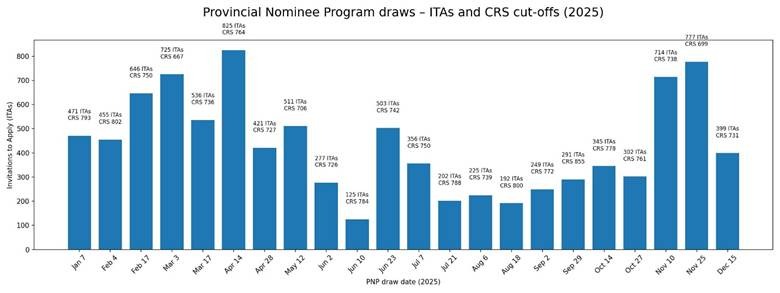
Throughout the year, PNP draws consistently recorded the highest CRS cut-offs in the system, reflecting the additional 600 CRS points awarded to nominated candidates.
Small draws, consistently high CRS
PNP draws occurred frequently in 2025, often every two to three weeks, but invitation numbers were relatively modest. Most draws issued between 125 and 800 ITAs, with CRS scores typically ranging from the high 600s to the mid-800s.
Several draws illustrate this pattern clearly:
- Early-year intensity
January and February draws showed CRS scores near or above 800, including CRS 802 on February 4 and CRS 793 on January 7, despite invitation numbers well below 500. - Mid-year stability
From March through August, PNP draws maintained a steady rhythm. CRS scores generally sat between 706 and 784, with invitation numbers often in the 200–500 range. - Late-year peak CRS
The highest CRS of the year, 855, occurred on September 29, underscoring how competitive PNP-linked Express Entry profiles can be even when invitation volumes are modest. - Year-end expansion
In November and December, IRCC issued larger PNP draws, including 714 ITAs on November 10 and 777 ITAs on November 25, with CRS cut-offs easing slightly into the 699–738 range.
Why CRS stays high in PNP draws
Unlike other Express Entry categories, PNP draws do not reflect general pool competitiveness. Instead, they reflect a mechanical scoring outcome:
- Provincial nomination adds 600 CRS points
- Most nominated candidates already have competitive base scores
- As a result, CRS cut-offs remain high even when draw sizes increase
This is why a CRS score above 700 in PNP draws does not indicate extreme competition, but rather the presence of nomination points.
Draw cadence and provincial control
The 2025 data shows that PNP draws were regular but constrained. Provinces operate under annual nomination allocations set by IRCC, which limits how many candidates they can nominate at any one time.
This explains why PNP draws remained relatively small throughout the year, even as CEC and French-language draws scaled up significantly.
PNP volume by period
While draw sizes fluctuated, the annual pattern is clear:
- Early year – high CRS, modest invitation numbers
- Mid year – stable cadence with consistent volumes
- Late year – slightly larger draws as provinces used remaining allocations
This suggests that provinces managed their quotas carefully, with some acceleration toward the end of the calendar year.
What the 2025 PNP data tells applicants
For Express Entry candidates, the message from 2025 is straightforward. A provincial nomination effectively guarantees an invitation, regardless of broader CRS trends.
However, securing a nomination remains the real challenge. PNP streams are selective, occupation-specific, and quota-limited. For candidates who can align their profiles with provincial priorities, PNPs remained the most reliable route to permanent residence through Express Entry in 2025.
Healthcare and social services draws in 2025
Healthcare and social services draws were a central feature of Express Entry in 2025 and one of the clearest expressions of IRCC’s labour market priorities. These category-based draws targeted candidates in critical frontline and support roles and consistently produced lower CRS cut-offs than Canadian Experience Class draws, while issuing meaningful numbers of Invitations to Apply (ITAs).
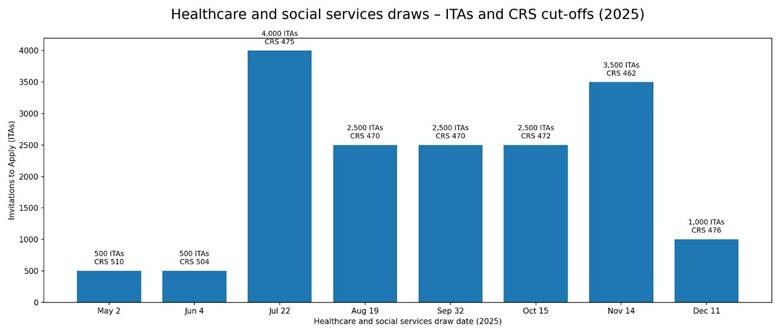
Across the year, healthcare and social services draws provided a distinct middle pathway within Express Entry – more accessible than CEC for many candidates, but more targeted than French-language rounds.
A steady, purpose-driven intake
Unlike the sharp pauses and surges seen in CEC draws, healthcare and social services draws followed a deliberate and steady cadence throughout 2025.
Key characteristics included:
- Regular draw frequency
Healthcare and social services draws appeared at regular intervals from spring through late autumn, signalling sustained demand rather than one-off intake initiatives. - Moderate to large draw sizes
Most draws issued 500 to 4,000 ITAs, with several large rounds issuing 2,500 or more invitations, particularly in mid and late 2025. - Accessible CRS thresholds
CRS cut-offs generally ranged from the low 460s to just over 500, sitting well below CEC thresholds for much of the year.
CRS behaviour in healthcare draws
Healthcare and social services CRS scores showed greater flexibility than other non-francophone categories.
Examples from 2025 illustrate this clearly:
- Early draws in the spring and early summer issued 500 ITAs with CRS scores around 504 to 510, already below typical CEC levels.
- Larger mid-year and autumn draws issuing 2,500 to 4,000 ITAs saw CRS cut-offs fall further, into the mid-to-high 460s.
- Late-year draws maintained CRS scores in the 470 range, even as invitation numbers increased again.
This pattern shows IRCC using draw size as a tool to reach deeper into the pool when labour shortages intensified.
Why healthcare and social services draws matter
Healthcare and social services draws behaved differently because they were driven by urgent, system-wide workforce needs rather than general immigration balance.
These draws targeted occupations across:
- Healthcare professionals
- Allied health workers
- Social services and care providers
By isolating these occupations, IRCC avoided competing directly with high-scoring candidates in other fields and accelerated permanent residence pathways for workers already supporting Canada’s healthcare and social infrastructure.
Position within the Express Entry system
In practical terms, healthcare and social services draws sat between CEC and French-language draws in terms of competitiveness:
- CRS cut-offs were consistently lower than CEC
- Invitation volumes were higher and more predictable than PNP draws
- Access was limited strictly to candidates in eligible occupations
For many candidates in healthcare roles, these draws represented the most realistic Express Entry pathway in 2025.
Volume pattern over the year
While healthcare draws did not follow strict quarterly cycles, the annual pattern is clear:
- Spring launch – smaller, cautious draws as the category ramped up
- Mid-year expansion – larger, frequent draws responding to labour shortages
- Late-year consistency – continued draws with stable CRS thresholds
Unlike CEC, there was no prolonged pause, reinforcing the idea of sustained demand rather than intake management.
What the 2025 healthcare data tells applicants
The 2025 data sends a strong message to healthcare and social services workers. Occupation matters more than ever within Express Entry.
Candidates in eligible healthcare roles benefited from lower CRS thresholds, repeated draw opportunities, and predictable intake patterns. For many, healthcare and social services draws offered a faster and more attainable route to permanent residence than general Express Entry competition.
The broader takeaway is clear. In 2025, Canada used Express Entry as a workforce tool, and healthcare and social services occupations were among its highest priorities.
Remaining Express Entry categories in 2025
Beyond Canadian Experience Class, French-language proficiency, Provincial Nominee Program, and healthcare and social services draws, IRCC continued to use targeted category-based draws in 2025 to address specific labour shortages. These remaining categories played a supporting but strategic role, with fewer draws and smaller volumes, but clear policy intent.
Education occupations
Education occupation draws were limited in number in 2025, but their purpose was clear.
IRCC issued education-specific draws in April and September, targeting teachers and education professionals facing shortages across several provinces. Invitation numbers were modest compared with healthcare or French-language draws, but CRS cut-offs were meaningfully lower than Canadian Experience Class levels, generally sitting in the mid-to-high 460s.
The limited frequency suggests that education draws were designed as targeted interventions rather than a sustained intake stream. When issued, they provided a strong opportunity for eligible candidates who may not have been competitive in general or CEC draws.
Trade occupations
Trade occupation draws appeared only once in 2025, in September, with 1,250 ITAs issued at a CRS cut-off of 505.
While the draw volume was respectable, the higher CRS threshold compared with healthcare or education categories suggests a more competitive pool. This likely reflects the overlap between trade workers and candidates already eligible under Canadian Experience Class or Provincial Nominee Program pathways.
The single draw indicates that trades were treated as important but situational, with provinces and employers continuing to rely heavily on PNP streams and temporary work permits to meet ongoing demand.
How these categories fit into the broader 2025 strategy
The limited use of education and trades draws shows that IRCC treated these categories as precision tools rather than core intake mechanisms.
In contrast to sustained healthcare and social services draws, frequent Canadian Experience Class rounds, and large French-language draws, education and trades categories were deployed selectively. This points to short-term labour market adjustments rather than long-term structural shortages.
CRS competitiveness compared with other categories
In relative terms, CRS cut-offs for these categories were lower than Canadian Experience Class draws but generally higher than healthcare and French-language draws. Invitation numbers were too small to materially affect overall pool competitiveness, meaning eligibility mattered more than marginal CRS differences.
What this means for applicants
The 2025 data suggests a clear hierarchy within Express Entry categories.
Some categories, such as healthcare and French-language proficiency, offered repeatable and predictable pathways. Others, including education and trade occupations, functioned as opportunity windows that opened briefly and without much notice.
For candidates in these remaining categories, readiness mattered more than long-term CRS planning. Those with up-to-date profiles and supporting documents were best positioned to benefit when IRCC activated these targeted draws.
Overall takeaway
In 2025, IRCC used category-based draws with varying intensity and purpose. While education and trade occupations did not dominate Express Entry, their inclusion confirms that occupation-specific selection is now a permanent feature of Canada’s economic immigration system.
Applicants should no longer view Express Entry as a single competition. The 2025 experience reinforces that it operates as a portfolio of pathways, some continuous and others episodic, shaped by policy priorities rather than CRS scores alone.
CRS score ranges by Express Entry draw type in 2025
CRS cut-off scores in 2025 varied far more by draw category than by time of year. Rather than operating as a single, unified ranking system, Express Entry functioned as a set of parallel selection pathways, each with its own competitiveness profile and policy purpose.
The figures below summarise how widely CRS thresholds differed depending on the type of draw conducted by IRCC.
CRS score ranges by draw type
| Express Entry draw type | Approximate CRS range in 2025 | What this reflects |
| French-language proficiency | 379 – 446 | Large, high-volume draws driven by federal francophone immigration targets rather than general pool competitiveness |
| Healthcare and social services | 460 – 510 | Sustained labour shortages allowing IRCC to reach deeper into the pool for priority occupations |
| Canadian Experience Class | 510 – 535 | Strong competition among temporary residents already working in Canada |
| Provincial Nominee Program | 700 – 855 | The automatic addition of 600 CRS points for candidates with a provincial nomination |
What the spread tells us
The gap between the lowest and highest CRS cut-offs in 2025 exceeded 470 points, from the high 300s in French-language draws to the mid-800s in some PNP rounds. This difference was structural, not incidental.
French-language draws consistently reached deep into the pool because IRCC was targeting a specific linguistic outcome. Healthcare and social services draws sat in the middle range, balancing occupational demand with overall intake levels. Canadian Experience Class draws reflected sustained competition among in-Canada candidates with strong human capital profiles. Provincial Nominee Program draws appeared the most competitive on paper, but this was largely mechanical due to the 600-point nomination bonus.
Why CRS alone no longer tells the full story
The 2025 data makes one point unmistakable. CRS score alone was no longer a reliable indicator of an applicant’s chances of receiving an invitation.
Eligibility for a specific draw category often mattered more than overall CRS rank. A candidate with a CRS score in the low 400s could receive an invitation through a French-language draw, while another candidate with a score above 500 could remain uninvited outside a targeted category.
Overall takeaway
Express Entry in 2025 did not operate as a single competition with a single cut-off. Instead, it functioned as a segmented system, with multiple pathways running in parallel and very different entry thresholds.
For applicants, the implication is clear. Strategy, eligibility, and alignment with IRCC priorities mattered more than chasing incremental CRS points alone.
Looking ahead to 2026
The way Express Entry operated in 2025 provides a strong indication of where the system is heading in 2026. Rather than reversing course, IRCC appears set to deepen its use of targeted, outcome-driven selection.
One of the most significant developments moving into 2026 is the introduction of a dedicated Express Entry category for physicians with Canadian work experience. This marks a further evolution of occupation-based selection, recognising that attracting doctors is no longer enough – retention within Canada’s healthcare system is now the priority. By targeting physicians already practising in Canada, IRCC is aligning immigration selection directly with provincial licensing realities and long-standing healthcare shortages.
More broadly, Express Entry in 2026 will operate within the framework of the 2026–2028 Immigration Levels Plan. While overall permanent resident targets remain stable, the plan places greater emphasis on economic immigrants who can integrate quickly, fill persistent labour gaps, and reduce pressure on housing and public services. This reinforces the focus on Canadian Experience Class candidates, francophone immigration, and occupation-specific draws tied to essential services.
What is unlikely to return is a system dominated by large, general draws. The evidence from 2025 suggests Express Entry has permanently shifted away from a single, unified competition toward managed intake through multiple parallel pathways.
For prospective applicants, the message heading into 2026 is clear. Success will depend less on marginal CRS gains and more on strategic alignment – Canadian work experience, language ability, occupational relevance, and provincial needs will continue to define who receives an invitation.
Express Entry is no longer just a ranking system. It is now a policy tool – and 2026 will further cement that reality.
Frequently Asked Questions
Was Express Entry easier or harder in 2025?
Express Entry was neither universally easier nor harder in 2025. Outcomes depended heavily on draw category. Candidates with Canadian work experience, French-language ability, or eligibility under targeted occupation draws faced lower CRS thresholds, while those outside priority categories encountered a more competitive system.
Why did CRS scores vary so widely between draw types?
CRS scores varied because Express Entry no longer operated as a single competition. IRCC ran multiple draw streams in parallel, each with different policy goals. French-language and healthcare draws reached deeper into the pool, while PNP draws reflected the automatic 600-point nomination bonus.
Did Canadian work experience matter more in 2025?
Yes. Frequent Canadian Experience Class draws showed that IRCC strongly prioritised candidates already working in Canada. This approach supports labour market continuity, faster integration, and reduced settlement risk, making Canadian work experience one of the strongest advantages in Express Entry.
Is French-language proficiency still important for Express Entry?
French-language proficiency remained one of the most powerful advantages in 2025. Large, high-volume French-language draws produced the lowest CRS cut-offs in the system, allowing eligible candidates to receive invitations at scores far below other draw types.
What should Express Entry candidates focus on going into 2026?
Candidates should focus less on marginal CRS improvements and more on strategic alignment. Canadian work experience, French-language ability, eligibility for targeted occupation draws, and provincial nomination pathways are likely to remain the strongest routes as Express Entry continues to evolve under the 2026–2028 Immigration Levels Plan.
